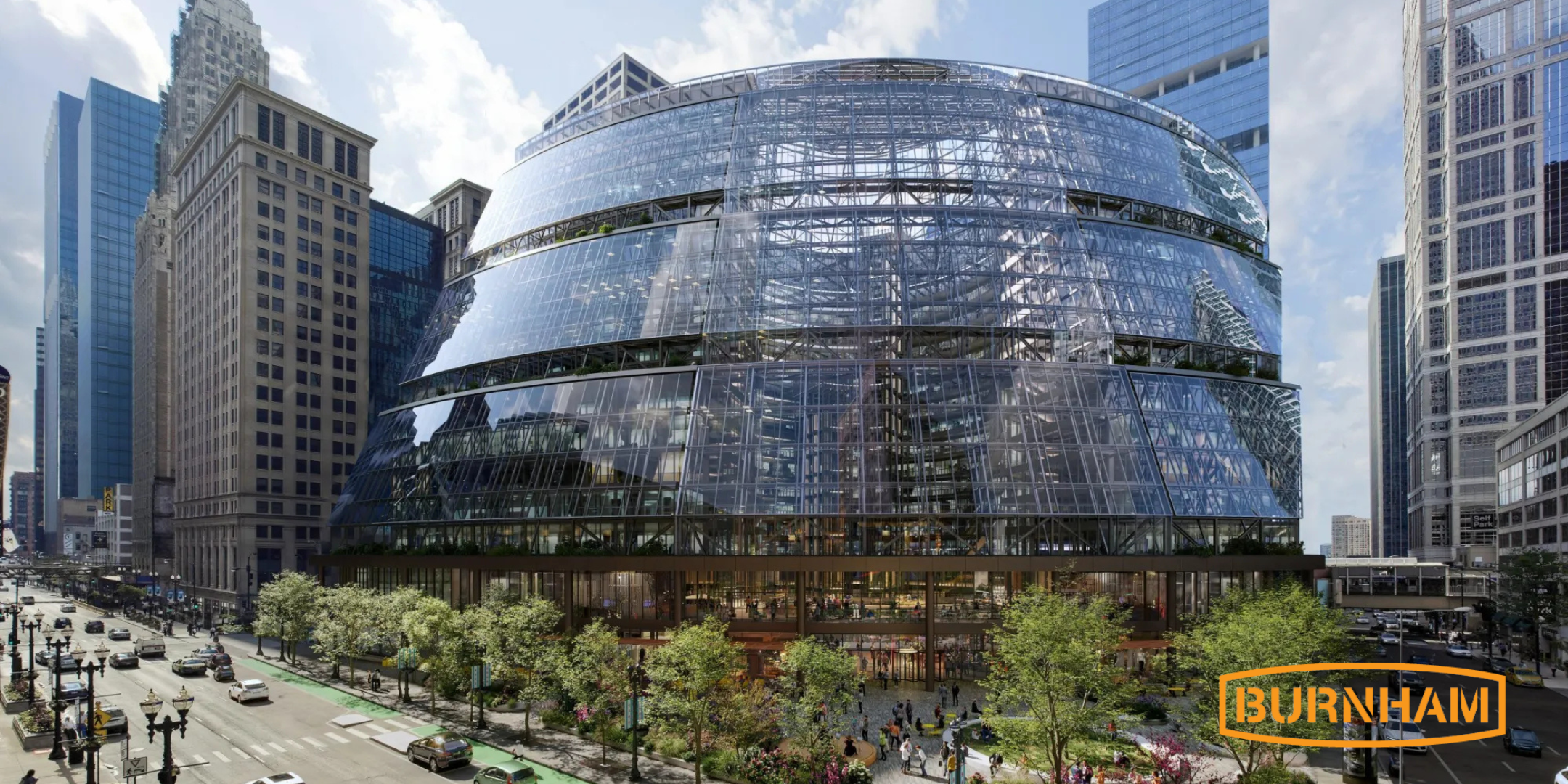
No project captures this conversation better than Google's Thompson Center — amenity-driven, code-complex, and happening in our backyard.
With downtown office vacancy rates soaring to all-time highs (28.6% in Chicago during the first quarter of 2026 per CBRE), the need to attract and retain tenants is ever greater.
The Office Amenities Arms Race
The recent accelerated trend to add amenities to multi-story office buildings is being driven not only by vacancy rates but by the need to transform workplaces from simple, functional spaces into experiential destinations that attract employees back to the office in a hybrid work era. As remote work remains popular, landlords and developers are investing in services and spaces—such as fitness centers, rooftop lounges, and high-end cafes—to differentiate their assets, increase tenant retention, and justify rental premiums.
Key reasons for this trend include:
-
Return-to-Office Incentives: High-quality curated amenities (e.g., yoga studios, wellness areas) make the office a "destination" that offers a better experience than working from home.
-
Talent Recruitment and Retention: Modern employees prioritize wellness and work-life balance. Highly amenitized buildings help companies attract top talent and boost employee satisfaction.
-
The "Amenities Arms Race" for Tenant Demand: Properties with diverse amenities (e.g., meeting spaces, food & beverage, fitness) are, by some reports, experiencing 12% higher demand compared to, non-amenitized counterparts.
-
Maximizing Asset Value: While requiring initial capital expenditure, amenities justify higher rental rates, increase property value, and reduce the high costs associated with tenant turnover.
-
Promoting Social Connection and Collaboration: Amenities like communal lounges, shared outdoor spaces, and integrated retail facilitate networking and social interaction, which are crucial for organizational culture in a hybrid environment.
-
Focus on Wellness and Safety: Post-pandemic, health-focused amenities—such as enhanced air filtration systems, contact-free technology, and meditation rooms—have become crucial for employee comfort.
In essence, landlords are shifting from selling "space" to selling "workplace experience," utilizing amenities to build a community-oriented ecosystem that makes the office indispensable.
When "Office" Stops Being the Occupancy
Adding amenities such as fitness centers, cafes, lounges, or conference centers to multi-story office buildings often triggers significant building code issues because the usage changes from low-density, B-occupancy (business) to high-density, A-occupancy (assembly) or specialized uses. These changes commonly involve challenges related to occupant load, egress, structural capacity, and accessibility.
The Code Challenges Nobody Budgets For
Key building code issues resulting from these retrofits include:
- Changes in Occupancy Classification: Transforming a standard office floor into a gym, auditorium, or large conference area can shift the occupancy classification, requiring stricter life safety standards (fire suppression, smoke detection, exit widths).
- Emergency Egress and Occupant Load: Amenities like conference centers or cafes increase the density of people on a floor. This requires recalculating the occupant load and often requires wider exits, more stairways, or closer exit proximity, which are difficult to upgrade in existing buildings.
- Structural Load Capacity: Gyms, heavy library shelves, or intensive cafe equipment (refrigerators, pizza ovens) create higher floor loads than typical office furniture. Existing floor slabs may need reinforcement to handle increased weight, requiring structural upgrades to columns and beams.
- Plumbing Fixture Upgrades: Cafes, restaurants, or fitness centers (especially those with showers/lockers) drastically increase the required number of plumbing fixtures (toilets, sinks). The existing plumbing stacks may not be able to accommodate these new requirements, creating logistical issues.
- ADA Accessibility Compliance: Upgrades frequently trigger the need for better ADA compliance, such as improving accessible routes, adding wheelchair-accessible restrooms, and increased signage. When adding a new, separate amenity space, the entire space must be fully accessible.
- HVAC and Ventilation Upgrades: High-occupancy areas like cafes and gyms require significantly more fresh air ventilation than empty office spaces. Retrofitting ductwork and HVAC units to meet current energy codes and air-change standards is often necessary.
- Fire-Rated Assemblies: Altering spaces to add kitchens or gym areas may breach existing fire-rated partitions, require repairs and require upgrades to fire suppression systems (sprinklers).
- Electrical System Upgrades: Adding specialized equipment for gyms or full-service cafes often exceeds the existing electrical capacity of the floor, necessitating new electrical panels and wiring.
These "alterations," under building codes, can also lead to cases where compliance is technically infeasible, necessitating detailed reviews with local building officials regarding alternatives or variances.
When Variances Enter the Picture
Key Code Compliance and Potential Variances:
- Accessibility Upgrades (IBC/Chapter 11): When altering areas containing a "primary function" (e.g., renovating a floor to add an amenity lounge), an accessible route to that area must be provided. If existing restrooms are not accessible and renovating them is technically infeasible, a variance for a single unisex restroom may be needed.
- Structural Load and Safety (IEBC): Adding heavy amenities (e.g., a green roof, heavy gym equipment) may require a variance or structural upgrades if the existing structure's demand-capacity ratio is increased by more than 10%.
- Means of Egress and Occupant Load: Introducing amenities like cafes or conference centers increases the occupant load, which may trigger requirements for wider exits, additional stairways, or improved fire alarm systems.
- Fire Protection Systems: Adding amenities might require extending automatic sprinkler systems (in accordance with Section 903.3.1.1) throughout the new area, even if the existing building is not fully sprinkled.
- Energy Code Compliance (C502): New amenity spaces must conform to energy efficiency standards regarding lighting, insulation, and HVAC, often requiring energy code compliance for the new, specialized usage.
When Variances Are Required: Technical infeasibility comes up more than people expect. Consider a 1970s office tower adding a rooftop amenity lounge. The existing stair configuration may not support the required egress width for the new assembly occupancy, and there's simply no structural or spatial path to widen it. That's the moment you're sitting across from a building official explaining what 'maximum extent feasible' actually means in practice.
Substantial Improvement: Cost thresholds catch more teams off guard than you'd expect. A landlord investing $4 million in a full-floor amenity conversion on a 1980s building may cross the threshold that triggers whole-building code compliance. Suddenly a single-floor project becomes a building-wide conversation about sprinkler systems, egress, and accessibility upgrades that were never in the budget.
Historic Buildings: Picture a pre-war office tower in the Loop adding a rooftop lounge. The required egress stair addition would punch through a terra cotta facade that's part of the historic designation. Compliance as written is off the table. Now you're coordinating between the building department, the landmarks commission, and your structural engineer to find an alternative that satisfies life safety without destroying what made the building worth saving in the first place.
If the combination of the new amenity and the existing building exceeds the allowable height or area, specific code provisions for additions (like constructing fire walls) will apply to avoid a full code upgrade of the entire structure.
Why Early Code Analysis Changes Everything
Performing an early building code analysis is critical for project success, as it identifies regulatory constraints before they become costly, time-consuming, or disruptive changes during later, more expensive design or construction phases. Integrating these requirements during the concept and schematic design stages allows teams to identify potential conflicts, such as fire safety requirements, egress, and zoning regulations, which can significantly alter building design if discovered late.
Key Benefits of Early Code Analysis:
- Preventing Costly Revisions: Catching conflicts early such as spatial violations, inappropriate material selections, or fire-rated separation requirements avoids expensive changes that can increase costs by up to 14% when detected late.
- Avoiding Scheduling Delays: Proactive code review reduces the need for redesigns, allowing for a faster, more linear approval and permitting process.
- "Front-Loading" Decisions: By engaging in early planning, stakeholders can resolve compliance concerns before they cascade into major, expensive modifications, ensuring better coordination with local authorities.
- Leveraging Technology (BIM)(AI): Tools like Building Information Modeling (BIM) and Artificial Intelligence (AI) allow teams to spot code violations earlier (e.g., clash detection for safety compliance).
The architects and owners who navigate these projects well share one habit: they ask the code questions before the design gets too far along. Once a rooftop lounge is three months into design development, the conversation about occupancy reclassification is painful. At concept stage, it's just planning.
Burnham Can Help
Amenity retrofits are one of the most code-complex project types in commercial real estate right now. Occupancy reclassifications, egress recalculations, accessibility triggers, variance negotiations. These aren't surprises if you bring the right team in early.
Burnham Nationwide specializes in permit expediting and code consulting for exactly these situations. We know how to read an existing building against current code requirements, identify where the conflicts are, and work with local building officials to find a path forward before those conflicts become budget problems.
If you're planning an amenity addition or office retrofit, let's talk before the design gets too far along. That's where we do our best work.